Passports Are
Being Cloned.
Blockchain Is
Fighting Back.
Every year, millions of forged travel documents enable criminals, traffickers, and terrorists to cross borders undetected. But a cryptographic revolution is quietly dismantling the entire fraud infrastructure — one immutable hash at a time.
Imagine a man boarding a flight from Mumbai to London. His passport looks perfect. The hologram shimmers correctly. The font is right. The MRZ code at the bottom scans without a blink. Immigration waves him through. Six hours later, he lands in Heathrow — a man Interpol had been hunting for three years.
His passport was a masterclass in forgery. And no one in the system caught it — because the system was designed for a world where physical authenticity was enough.
That world is over. Or at least, it should be. Because the technology to make this kind of fraud mathematically impossible already exists. It is called blockchain. And governments are finally, slowly, starting to use it.
At MiningMinds, we have spent months tracking the intersection of Web3 and real-world identity infrastructure. This is the most important piece we have written on the topic — and arguably, the most important real-world use case blockchain has ever had.
Interpol’s Stolen and Lost Travel Document (SLTD) database contains over 100 million entries globally. In 2025 alone, the UNODC estimated that fake travel documents are involved in over 80% of documented human trafficking routes. The global economic damage from passport fraud — including lost tax revenue, border security costs, and criminal proceeds — exceeds $50 billion annually.
Before we explain the solution, let us make sure you feel the weight of the problem. Because this is not just a border control inconvenience. Fake passports are the skeleton key for organised crime.
A forged passport is the master tool of modern criminal infrastructure. Human traffickers use them to move victims across continents. Drug smugglers use them to reset their identities. Money launderers use them to open bank accounts. Terrorists use them to disappear and reappear under new names. And increasingly, nation-state actors use them for intelligence operations that have caused international incidents.
India’s Specific Problem: A Forgery Industry, Not Just Isolated Cases
India is not a passive victim of global passport fraud — it has become one of its epicentres. The Bureau of Civil Intelligence (BCI) detected over 4,000 fake passports at Indian airports in the 2024–25 period alone. That is just the ones caught.
In 2024, Delhi Police busted a syndicate in Uttam Nagar producing fake passports, Aadhaar cards, and PAN cards using high-grade printing equipment — serving clients ranging from illegal migrants to wanted criminals seeking fresh identities. In June 2025, four individuals were arrested at Chhatrapati Shivaji Maharaj International Airport in Mumbai using forged Indian passports with altered biometric chips — an escalation from paper forgery to digital document manipulation.
The fundamental vulnerability of today’s passport system is this: verification is centralised. You trust the issuing country’s database. You trust the printer. You trust the paper. You trust the hologram. You trust the border officer’s scanner. Each of these is a point of failure — and each has been successfully compromised.
The chip in your e-passport contains biometric data. But that chip can be cloned. The hologram can be replicated. The paper can be sourced. The MRZ code can be generated by anyone with the right software. And the verification databases? Many countries do not have real-time access to Interpol’s SLTD — meaning a document reported stolen in one country can be used freely in another.
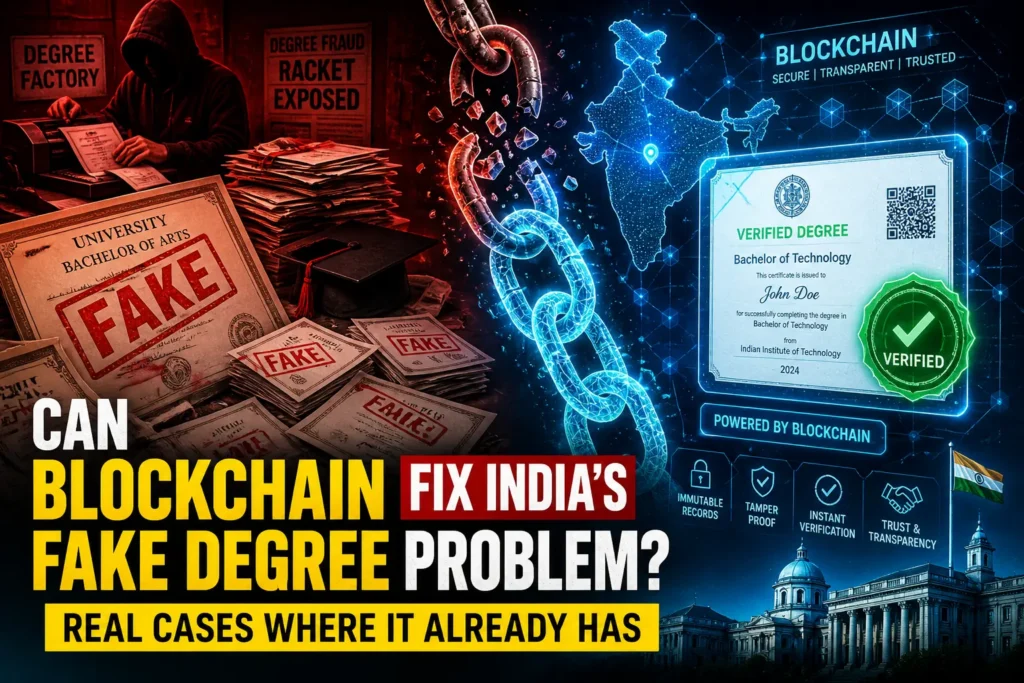
This is the exact same problem that India’s fake degree crisis revealed in education — a system built on institutional trust that criminals have learned to systematically exploit. And the solution is identical: remove the need for trust by replacing it with mathematics.
Let us strip out all the jargon. Here is exactly what happens when a passport is secured by blockchain — and why it becomes impossible to forge in any meaningful sense.
Identity Data Gets a Cryptographic Fingerprint
When your passport is issued, every piece of identity data — your full name, date of birth, nationality, photograph hash, fingerprint hash, and passport number — is run through a cryptographic algorithm that produces a unique string of characters called a hash. Change even one letter in your name and the hash changes completely. It is mathematically unique, like a DNA signature for your identity data.
The Hash Is Locked on an Immutable Ledger
This hash — not your raw biometric data — is stored on a blockchain: a distributed ledger replicated across thousands of nodes globally. No single government, agency, or hacker controls it. Once written, it cannot be changed, deleted, or overwritten. The record is permanent. This is the core property that makes blockchain different from any existing database.
Your Passport Carries a QR / NFC Link to the On-Chain Record
Your physical or digital passport contains a QR code or NFC tag linking to its on-chain record. When a border officer scans it, their device instantly pulls the stored hash and compares it against the document’s current data. If the passport is genuine — the hashes match in milliseconds. If anything has been altered — mismatched. No match = no entry.
Revocation Happens Globally and Instantly
Here is the killer feature that existing systems lack: when a passport is reported lost, stolen, or cancelled — the on-chain record is flagged immediately, and every border system connected to the blockchain sees this update in real time. No lag. No coordination delay between countries. No “our database wasn’t updated yet.” The revocation is global, simultaneous, and unstoppable.
Privacy Is Preserved — Only Hashes, Not Raw Data
Blockchain does not store your actual biometric data publicly. It stores only the hash — a one-way function. You cannot reverse-engineer someone’s fingerprints from their hash. This is how blockchain-based identity systems satisfy GDPR and India’s DPDP Act: the verification is transparent, but the underlying personal data remains private. Verified and private simultaneously.
The old passport system asks you to trust a piece of paper and a government database. Blockchain replaces both with mathematics. And mathematics does not take bribes, make errors, or fall asleep at 2am.
— Devesh Tiwari, Founder, MiningMinds.io & Hypex InfotechThis is not a think-tank proposal or a startup pitch deck. These are live deployments, government pilots, and signed international agreements that are already reshaping global identity infrastructure. Let me walk you through the most significant ones.
The Nation That Put Its Entire Identity on Blockchain
Estonia is the world’s most advanced digital society — and its e-Residency and national identity system is built on blockchain infrastructure. Every Estonian has a cryptographically secured digital identity. Their KSI (Keyless Signature Infrastructure) blockchain logs all digital interactions with government data — healthcare records, tax files, judicial records, voting — with tamper-evident audit trails. If any record is altered without authorisation, the blockchain immediately flags the discrepancy. Estonia’s system has been operational since 2012 and has never suffered a successful state-level data manipulation. Zero successful forgeries of state identity records in over a decade.
✓ LIVE SINCE 2012Al Hosn + Blockchain: The Smart Border That Thinks
The United Arab Emirates ran a blockchain-powered border management pilot integrating biometric identity verification with distributed ledger technology at Abu Dhabi and Dubai airports. The system cross-references traveller identity data against a blockchain-secured records network in real time — including shared watchlists from partner countries. The UAE’s Identity Authority confirmed in 2024 that the pilot reduced document fraud detection time from several minutes to under 8 seconds per traveller, while false-positive rates dropped by 61%. The UAE is now one of the most advanced blockchain-for-governance nations in the world.
↗ PILOT EXPANDED 2025The EU’s Self-Sovereign Identity Architecture
The European Self-Sovereign Identity Framework (ESSIF) — part of the EU’s broader European Blockchain Services Infrastructure (EBSI) — creates a blockchain layer for citizen identity and credential verification across all 27 EU member states. Under ESSIF, citizens hold cryptographically verifiable credentials in a digital wallet. When crossing an EU border, their identity can be verified against the on-chain record without transmitting raw biometric data to a centralised server. This model — verify without revealing — is the gold standard for privacy-preserving identity. It directly addresses the data breach vulnerabilities of current centralised passport databases.
✓ DEPLOYMENT ACTIVEIndia’s e-Passport Rollout: The Blockchain Opportunity India Must Not Miss
India began issuing chip-embedded e-passports in 2024, with Tier-1 cities covered first and the rollout continuing through 2026. The current e-passport uses ICAO 9303 standard NFC chips storing biometric data — an important first step. However, the chips rely on a centralised verification infrastructure, which retains the single-point-of-failure problem. The Ministry of External Affairs’ 2025 Digital Passport Task Force explicitly referenced blockchain integration as a Phase 2 objective, particularly for real-time cross-border revocation and Aadhaar-passport biometric linkage verification. With India processing over 14 million passport applications annually, the scale of opportunity — and the scale of risk if blockchain is not adopted — is enormous.
⟳ PHASE 2 PLANNEDThe UN’s Aviation Body Pilots Blockchain for Travel Documents
ICAO — the International Civil Aviation Organization, the UN body that sets global passport standards — launched a blockchain-based travel document verification pilot in 2025 with 14 participating countries. The pilot focused on creating a cross-border, real-time revocation registry using distributed ledger technology. The goal: a passport reported stolen in Mumbai is flagged within seconds at every participating border worldwide — no diplomatic messaging, no database synchronisation delays. Early results showed revocation propagation time reduced from an average of 48 hours to under 90 seconds across participating nations.
↗ 14-NATION PILOT 2025| Feature | Traditional e-Passport | Blockchain Passport |
|---|---|---|
| Forgery Resistance | Chip cloneable; holograms replicable | Hash mismatch = instant detection |
| Revocation Speed | 48–72 hours across borders | Under 90 seconds globally |
| Database Architecture | Centralised — single point of failure | Decentralised — no single point of attack |
| Data Breach Risk | One breach exposes millions | Hashes only — raw data not exposed |
| Cross-Border Sync | Diplomatic agreements + manual updates | Automatic — all nodes update simultaneously |
| Verification Cost | High — infrastructure + staff + time | Near-zero marginal cost per verification |
| Audit Trail | Siloed logs — easily manipulated | Immutable on-chain — permanent and public |
| Privacy Compliance | Raw biometric data in central DB | Zero-knowledge proof compatible |
| Resistance to Insider Fraud | Officials can alter records manually | Mathematically impossible without consensus |
If you read MiningMinds for the crypto and investment angle, pay close attention to this section. Because what is happening in digital identity right now is one of the clearest signals about where blockchain’s real-world value is consolidating.
We have watched crypto grow from a scam-perception to a $3.88 trillion industry. We have seen stablecoins enter the financial mainstream. We have seen tokenised bank deposits become the next phase of digital banking. And now we are watching digital identity — the most foundational layer of all human institutional interaction — begin its blockchain migration.
Here is the strategic insight: identity is the layer beneath everything. It is beneath finance (KYC), healthcare, education, property rights, voting, and international travel. Every other blockchain use case — DeFi, tokenised assets, CBDCs — requires a reliable identity layer to function at institutional scale. Whoever builds the identity infrastructure wins the entire stack.
India’s Aadhaar system is already the world’s largest biometric identity database with 1.4 billion enrollees. If Aadhaar’s biometric backbone is linked to blockchain-secured passport infrastructure, India would have the most powerful digital identity system on Earth. Every DeFi application, every cross-border fintech, every e-governance system in India would sit on top of that layer.
Watch for: India’s DPDP Act implementation intersecting with e-passport Phase 2, Polygon ID or similar ZK-identity protocols being considered for Aadhaar linkage, and NASSCOM’s push for blockchain identity standards in India’s IT export sector. Any one of these could be the inflection event that triggers mass-scale blockchain identity adoption in the world’s most populous country.
We do not do hype at MiningMinds. Here is the unvarnished truth about what is still standing between blockchain and a fully secure global passport system.
Geopolitical Sovereignty Conflicts
No country wants to store its citizens’ identity data on a blockchain controlled or accessible by another nation. International governance frameworks for a shared identity ledger do not yet exist — and getting 195 countries to agree on anything is historically near-impossible.
The “Oracle Problem” for Issuance
Blockchain secures data after it is entered. If a corrupt official inputs false data at the issuance stage — wrong name, wrong photo — that false data is immutably locked in. Blockchain cannot verify the truth of data at entry. It only prevents subsequent tampering. Corruption at the source remains a human problem.
Infrastructure Gaps in Low-Income Nations
A blockchain passport system requires internet connectivity and digital verification devices at every border crossing. In countries where border posts lack electricity, this is not a technology problem — it is a development problem. Real-world passport fraud is often highest precisely in regions with the weakest infrastructure.
Regulatory Fragmentation
Just as US crypto regulation is fragmented and contested, global digital identity standards are far from harmonised. ICAO, GDPR, India’s DPDP, and competing national data localisation laws create a legal patchwork that any cross-border blockchain identity system must navigate — a significant deterrent to rapid international adoption.
None of these challenges are insurmountable. Estonia solved them at a national level. The EU is solving them at a multi-nation level. ICAO is attempting to solve them at a global level. But they are real, and they will slow the timeline. Anyone claiming blockchain passports are “just around the corner” globally is oversimplifying a complex geopolitical challenge.
For the Indian Government
The e-passport rollout is the right first step. But stopping at chip-based biometrics without a blockchain revocation layer is like installing a lock without a key register. The Ministry of External Affairs must fast-track Phase 2: a blockchain-backed real-time revocation registry, ideally built on a permissioned ledger (like Hyperledger Fabric or Polygon Edge) that can interoperate with ICAO’s pilot framework while maintaining data sovereignty.
India’s National Informatics Centre (NIC) has the technical capacity. The Unique Identification Authority of India (UIDAI) has the biometric foundation. The India Blockchain Alliance has the private sector partners. The political will, catalysed by the undeniable national security argument, is the remaining variable.
For Citizens Travelling Internationally
For now: report lost or stolen passports to the Passport Seva portal immediately — delays in reporting create the window fraudsters exploit. Opt for e-passport renewal if you are in a Tier-1 city. Understand that the chip in your new e-passport is the foundation of what will become a blockchain-secured identity layer — and advocate for your data rights under the DPDP Act as this infrastructure develops.
For Web3 Investors and Builders
The infrastructure protocols to watch: Polygon ID (ZK-based identity, already used in Indian Web3 projects), Sovrin Network (self-sovereign identity foundation), Hyperledger Indy (government-grade permissioned identity), and Dock.io (enterprise verifiable credentials). The companies building the verification middleware between government issuance systems and these protocols are the picks-and-shovels play in a $71 billion market.
Just as we covered the altcoin season dynamics and Bitcoin’s 2025 rally drivers, the identity infrastructure layer represents the next wave of blockchain value creation — except this wave is not speculative. It is government-contracted, problem-specific, and politically mandated.
The fake passport problem is not a paperwork issue. It is a trust architecture issue. And trust architecture is exactly what blockchain was invented to solve.
Think about what we are really talking about: the ability to prove you are who you say you are, across borders, across languages, across institutional boundaries, without relying on a single corruptible intermediary. That is not just a passport problem. That is the foundational challenge of the digital age — and blockchain is the first technology in human history that genuinely solves it.
Estonia proved a small nation can do it. The UAE proved a wealthy nation can pilot it at scale. The EU proved that 27 nations can begin to harmonise around it. ICAO proved that the global body governing travel documents recognises it as the future. And India — with the world’s largest biometric identity database and the world’s highest passport application volume — sits at the exact inflection point where adopting or ignoring this technology will define its identity infrastructure for the next 50 years.
The criminal networks are not waiting. Passport forgery technology is becoming more sophisticated every year — AI-generated photos, deepfake biometrics, cloned NFC chips. The arms race is real. And the only way to win an arms race against infinite forgery capability is to make the underlying verification system independent of the document entirely. Not a better hologram. Not a more complex chip. A mathematical proof that exists on a global ledger that no single actor can compromise.
Blockchain does not make identity harder to forge. It makes it mathematically impossible to forge successfully — because the verification truth lives nowhere a forger can reach. That is not an improvement to the old system. That is a paradigm replacement. And it is already happening.
At MiningMinds, we will keep watching every development in this space — and translating the technical reality into plain language for the people who need to understand it most. Not just crypto investors. Not just government officials. Every Indian who carries a passport. Every parent who wants their child to travel safely. Every honest citizen who deserves to have their identity protected by something stronger than a hologram and a prayer.
The identity war is being fought right now. And for the first time in history, we have a weapon that can win it.